Studying under the Erasmus programme began with getting to know the city and region of Beja. On a city tour we learned about the history of Beja, which dates back to the 1st century BC, and visited the archaeological museum with the ruins of the ancient city and the medieval Beja Castle. Next, there was an excursion to the Alqueva reservoir with the dam of the same name on the Guadiana River. The dam was completed only 15 years ago, but has already significantly changed the landscape and agricultural production in the region: from desert to orchards and green fields.
Incidentally, the Alqueva reservoir was the subject of research in the Erasmus+ BIP IPBeja programme. Besides its positive environmental effects, the reservoir has a number of problems (pesticide pollution, increased eutrophication, parasitic fauna). The aim of the programme was therefore to address these problems with the help of students of different specialties from different countries by sharing knowledge and experience in teams. My team consisted of a biologist, an environmental engineer, a mechanical engineer and me (an ecologist).
Every day we had lectures by professors and lecturers from universities in the Netherlands, Poland, Brazil, Portugal and elsewhere. We studied the problems of researching rivers and water reservoirs and their solutions in order to find solutions for the Alqueva reservoir. After the theory we moved on to practice – using multispectral images from the Sentinel-2 satellite. Thanks to multispectral images and tools for processing them, we learned to see changes in water bodies, which helped identify the problem and the time when it is most widespread.
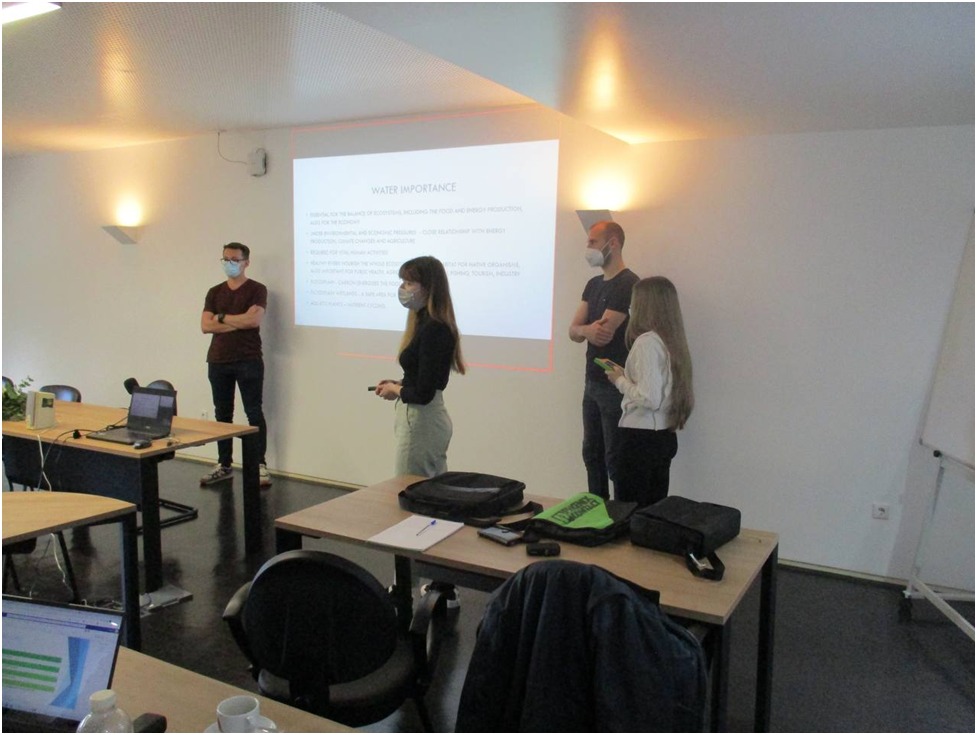
In addition, each stage of the project had to be presented within a short time, so each team was free to plan its work and the whole project, but had to present its progress every 2–3 days. This helped improve teamwork skills.
In the last days before the final project presentation, we held a “cultural time” where we got to know the country and culture of each student (Croatia, Belgium, the Netherlands, Nepal, Slovakia, Slovenia, Poland and Ukraine). There were many very interesting facts.
On 24 February, the management of the Polytechnic Institute of Beja immediately offered to extend our studies. Every day the lecturers express their solidarity with Ukraine and offer any help to Ukrainian students and their families.
Erasmus programme: Multi-Spectral Imaging and System Analysis: tools for smart water management
Anastasiia Oleksandrivna Tkachenko, group EK-456